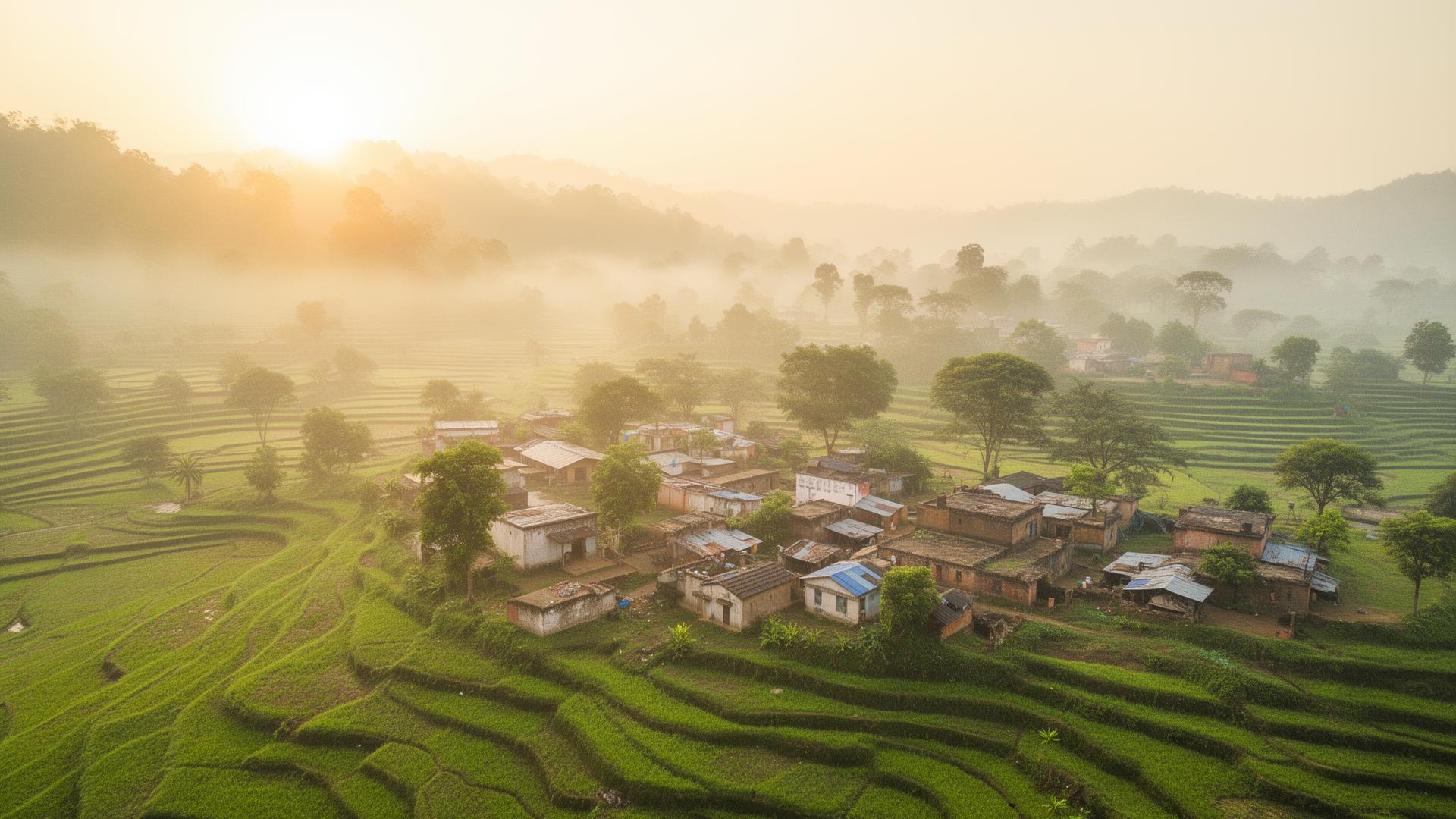
Indian rural village at sunrise
A Government-Grade Transformation Framework

From a single survey question to a national program.

The Samagra Gram Vikas Transformation Framework turns 377 grassroots survey questions across 6+ thematic domains into structured, budgetable, politically-viable development programs β€” through one disciplined eight-stage pipeline.

377
Survey questions
6+
Thematic domains
8
Pipeline stages
11D
Feasibility scoring
The Pipeline

Eight stages. Zero data wastage.

Every village survey question is the entry trigger to a comprehensive developmental analysis engine. No insight is lost. Each answer becomes a parameter, each parameter a diagnosis, each diagnosis an intervention β€” finally crystallizing into a named, budgeted, time-bound program.

  1. 01Stage

    Questionnaire

    Raw survey questions capturing ground-level reality

    β†’
  2. 02Stage

    Parameter Mapping

    Transformed into analytical parameters and derived indices

    β†’
  3. 03Stage

    Diagnostics & Insights

    Statistical intelligence β€” gaps, strengths, risk zones

    β†’
  4. 04Stage

    Strategic Interventions

    Evidence-based interventions linked to each insight

    β†’
  5. 05Stage

    11-D Feasibility

    Stress-tested across 11 strategic dimensions

    β†’
  6. 06Stage

    Impact Assessment

    Projected outcomes β€” income, inclusion, health, growth

    β†’
  7. 07Stage

    Prioritization

    Ranked by impact Γ— feasibility Γ— urgency Γ— scale

    β†’
  8. 08Stage

    Development Program

    Executable, structured programs with components

Five questions Β· five programs

Each question, walked through all eight stages.

Below are five sample questions hand-picked from the 377-question master survey. Tap a question to follow the full SGVTF pipeline β€” from the raw question, through derived parameters, diagnostics, interventions, an 11-dimensional feasibility scan, projected impact, prioritization, and finally a named, budgeted development program.

Question 01 Β· AgricultureMulti-select / Categorical Β· Family / Farm Household

The question

β€œWhat marketing medium is used to sell the crop produce?”

This question probes how farmers connect their produce to markets β€” mandis, middlemen, cooperatives, FPOs, or digital platforms. The answer unlocks the entire agricultural value chain architecture of a village.

Stage 02

Parameter Mapping & Derived Indices

One question, seven analytical parameters

Primary Marketing Channel
Direct
Survey answer
Middlemen Dependency Rate
Derived
% using middlemen vs direct
Digital Market Adoption Index
Derived
% using e-NAM / online platforms
FPO / Cooperative Participation
Derived
% selling through FPO / Co-op
Market Reach Score
Derived
Local vs regional vs national access
Income Leakage Coefficient
Computed
% income lost to intermediaries
Price Realisation Gap
Computed
MSP βˆ’ actual price received
Stage 03

Diagnostics & Insights

What the data is really telling us

70–80% sell through middlemen
Chronic income leakage β€” farmers receive 40–60% less than market price, perpetuating agrarian poverty.
Low FPO participation
Collective bargaining power untapped; individual farmers remain price-takers, never price-setters.
Negligible digital market use
Digital agricultural commerce infrastructure exists but awareness and adoption remain critically low.
Local-only market reach
Geographical limitation β€” produce with export potential remains confined to low-value local trade.
Stage 04

Strategic Interventions

Each insight, paired with a precise lever

Middlemen dependency
FPO formation and strengthening β€” collective market access
Low digital adoption
e-NAM onboarding and digital literacy for farmers
Price realisation gap
Direct buyer–farmer linkage programs and APMC reforms
Limited market reach
Value-chain development β€” agri-processing and export facilitation
Stage 05

11-Dimensional Feasibility

Stress-tested across every angle that matters

Strategic
HIGH
Operational
HIGH
Political
HIGH
Financial
MEDIUM
Time
MEDIUM
Technical
HIGH
Legal
HIGH
Social
HIGH
People
HIGH
Execution
MEDIUM
Market
HIGH
Stage 06

Impact Assessment

The change this program will create

Farmer Income
25–40% increase in net income through elimination of middlemen
Economic Growth
Strengthened local agricultural economy; higher money multiplier
Employment
New jobs in agri-processing, logistics, and digital operations
Food Security
Improved supply-chain efficiency reducing post-harvest losses
Women Inclusion
SHG-linked women's agri-processing units empowered
Stage 07

Intervention Prioritization

Sequenced for maximum return

Intervention
Tier
FPO Formation & Market Linkage
HIGHHIGHHIGH
P-1
e-NAM Digital Onboarding
HIGHHIGHMEDIUM
P-2
Agri-Processing Value Addition
MEDIUMHIGHMEDIUM
P-3
Stage 08

Development Program

From insight to executable initiative

Program

Kisan Bazaar

Integrated Agri-Market Linkage Program

FPO registration and capacity building
e-NAM digital onboarding for farmers
Direct-to-consumer market linkage
Agri-processing and value-addition training
Market intelligence dissemination via mobile
Cold chain and logistics support
The Outcome

Five questions. Five national programs.

A convergent, integrated development ecosystem covering economic empowerment, health security, human capital, social inclusion, and environmental sustainability.

Q01Agriculture

Kisan Bazaar

Integrated Agri-Market Linkage Program

Core Impact
25–40% increase in net income through elimination of middlemen
Q02Healthcare

Swasth Gram

Village Healthcare Access & Wellness Initiative

Core Impact
30–50% improvement in utilization rate within 12 months
Q03Skill Dev.

Yuva Shakti

Village Skill & Entrepreneurship Development Program

Core Impact
30–40% of trained youth placed in employment within 6 months
Q04Women Empowerment

Mahila Shakti Gram

SHG-led Women Empowerment & Livelihood Initiative

Core Impact
β‚Ή2,000–6,000 / month additional income per active SHG member
Q05Environment

Harit Gram

Village Circular Economy & Waste-to-Wealth Initiative

Core Impact
Elimination of open dumping; groundwater protection

β€œEvery survey answer is a seed. The SGVTF is the soil, structure, and sunlight that transforms it into a program that changes lives.”